Product
Seven things a desk needs in a market, computed from every recorded instrument in it: who owns what, what has traded, who has lent, what is distressed, and what has just been filed.
Ownership and entities
Who really owns a building, and everything else that owner controls in the market.
- The beneficial owner behind the entity on title, public or private resolved to one owner.
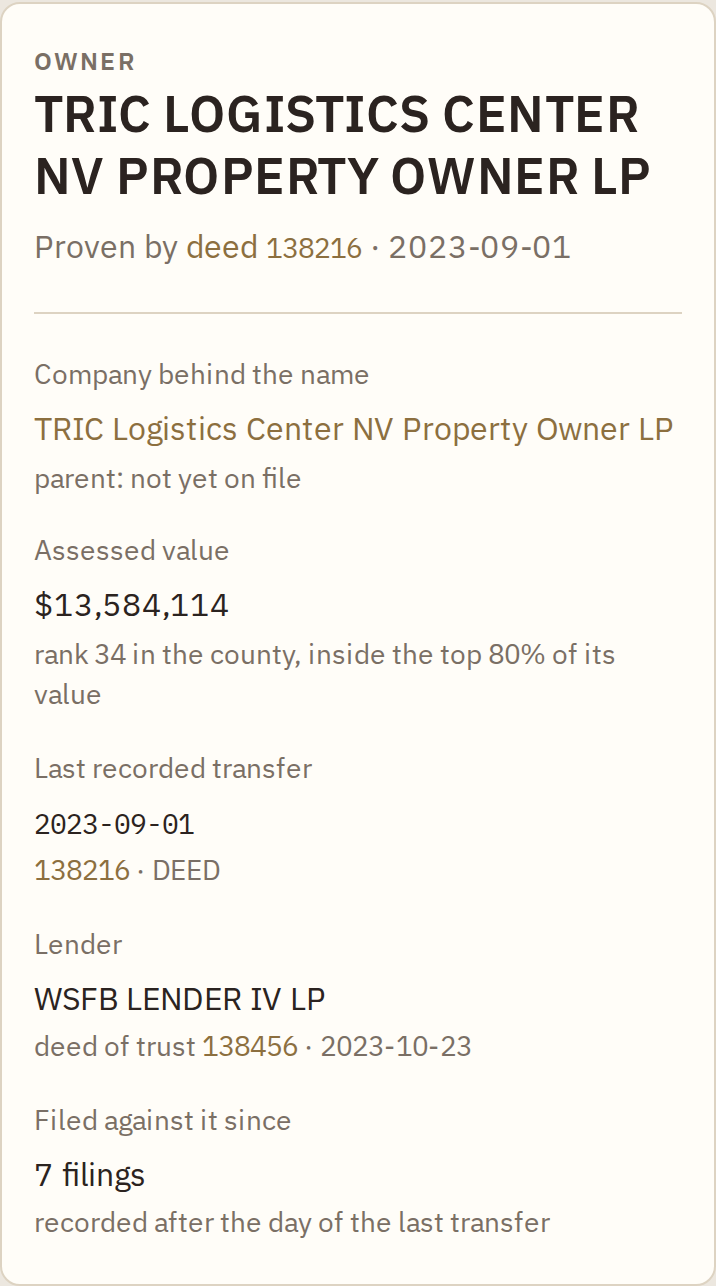
- An owner's portfolio across a market: every parcel, what it is, and what it is assessed at.
- The company behind the name on title, and the parent above it where one is on file.
- The largest owners in a market, ranked by parcels owned and by assessed value.
Transactions
Every sale and transfer in a market, in the parties’ own names.
- The buyer, the seller, the instrument, the date, and the price where it is disclosed.
- Comparable sales by market, submarket and property type.
- Every transfer on a parcel, each with the document number that proves it.
- Buyer and seller rankings, and transaction velocity in a market.
Debt and capital markets
Who lent, against what, and whose paper is moving.
- Originations by lender, with the borrower, the parcel and the amount as filed.
- Lender exposure by market across banks, mortgage REITs, debt funds and agency lenders.
- Assignments and note sales - whose paper is trading, and who is selling out of a market.
- Loan maturities, and how leveraged a borrower is against what it owns.
- CMBS loan-level activity and special-servicing transfers.
Distress
What gets filed when a deal goes wrong, the day it is filed.
- Notices of default, notices of sale and trustee's deeds.
- Lis pendens, receiverships and bankruptcies.
- Tax delinquency and tax liens, mechanics liens and judgments.
- A notice of default is filed first, and Nevada's foreclosure statute bars the notice of sale for three months after it - so these are leading indicators. We describe what has happened, never what will.
Land and public ownership
The ground itself, and how it changes hands.
- Vacant land by parcel, by acreage and by assessed value.
- BLM and other federal land, state and school-trust land, and tribal land.
- Water rights and mining claims.
- The auctions and tax sales that move them.
Public company activity
What the public filers are doing on the ground in a market.
- REITs, homebuilders and data center operators resolved to the parcels they own.
- What each bought and sold in a market, and what it financed against.
- The entity on title tied to the public parent behind it.
- A public owner's footprint in a market beside every other owner's.
Alerts and rankings
A standing watch on the parcels, names and markets you follow.
- Real-time alerts on any of the above, by parcel, owner, lender or market.
- A watchlist of the parcels and the names your desk works on.
- Standing rankings of the largest owners, lenders and buyers in a market.
- Every alert carries the instrument behind it: the parties, the document number and the date.
The edge
- Real-time alerts
- You are alerted the day an instrument is filed, not in a monthly refresh. A sale, a new loan, an assignment, a notice of default - you get it first.
- The whole instrument
- Every instrument that names a parcel or a name, the parties as printed, the document number and the image where there is one. Other desks carry a summary; you get what the summary was made from.
- One page per parcel
- All seven meet on one parcel: who owns it, what it is assessed at, when it last traded, who lent against it, and everything filed since.
On the screen
Access
Access is by subscription. See pricing, or see which markets are covered.